The Definitive Objective Guide to Wrist & Thumb Braces: Managing Arthritis, Tendonitis, and Sprains

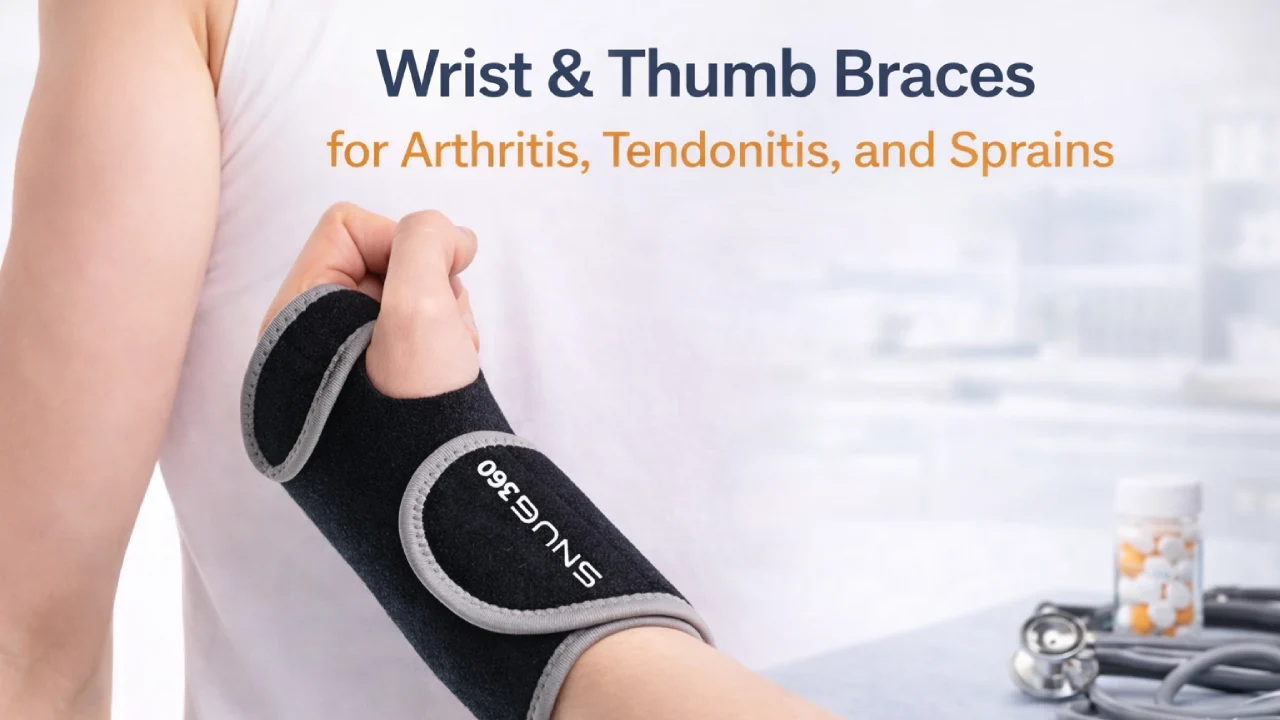
The Verdict: Thumb pain is not just a minor nuisance; it is a functional crisis. The thumb is responsible for approximately 40% to 50% of all hand function. When it hurts whether from the grinding ache of arthritis or the sharp sting of tendonitis your ability to perform basic tasks like holding a toothbrush, turning a doorknob, or typing an email is compromized.
The market is saturated with generic “wrist supports” that claim to help. Most of them are useless for thumb pain because they lack the specific structural component required: the Thumb Spica.
After an exhaustive analysis of the top medical and consumer brands—including Snug360, BraceAbility, BraceLab, DonJoy, Mueller, McDavid, and EzyWrap we have compiled this objective guide. We move beyond marketing fluff to look at the physics of immobilization, the breathability of materials, and the reality of daily wear.
- For the Office Worker & Athlete: The BraceLab Push Sports Thumb Brace is the superior choice. Its revolutionary “open palm” design stabilizes the joint without turning your hand into a useless paddle.
- For the Chronic Arthritis Sufferer: The Snug360 Thumb & Wrist Stabilizer offers the best balance of medical-grade compression and all-day comfort, utilizing breathable 3D knitting rather than sweaty neoprene.
- For Acute Injury & De Quervain’s: The BraceAbility Hard Shell Thumb Spica provides the rigid, cast-like immobilization necessary to stop tendon inflammation in its tracks.
Part 1: The Anatomy of Pain (Why You Hurt)
To choose the correct brace, you must first understand the biomechanics of your specific condition. A brace designed for a ligament sprain will often fail to treat tendonitis, and vice versa.
1. Basal Joint Arthritis (CMC Joint Osteoarthritis)
This is the most common cause of thumb pain in adults over 50, particularly women.
- The Anatomy: The Carpometacarpal (CMC) joint is where the thumb metacarpal bone meets the trapezium bone of the wrist. It is a “saddle joint,” allowing the thumb to swivel, pivot, and pinch.
- The Problem: Over decades of use, the cartilage cushioning this saddle wears away. Bone rubs against bone.
- The Sensation: A deep, dull, grinding ache at the very base of the thumb (near the wrist). It flares up when you apply force, such as pinching a key or opening a jar.
- The Bracing Goal: Stabilization & Unloading. You don’t need to immobilize the thumb completely. You need a brace that applies pressure to the joint to keep the bones aligned and prevents the “subluxation” (slipping) that causes the grind. Warmth is also critical for pain relief.
2. De Quervain’s Tenosynovitis (“Texting Thumb”)
This is an overuse injury common in new mothers (from lifting babies), gamers, and heavy smartphone users.
- The Anatomy: Two tendons (the EPB and APL) run along the thumb side of the wrist. They glide through a sheath (tunnel).
- The Problem: Repetitive motion causes the sheath to thicken and the tendons to swell. They can no longer glide smoothly; they get stuck.
- The Sensation: A sharp, shooting pain on the thumb side of the wrist, especially when you make a fist and tilt your hand downward (the Finkelstein test).
- The Bracing Goal: Rigid Immobilization. This is an inflammatory condition. The only way to stop the inflammation is to stop the friction. You need a brace that locks the thumb and wrist together, preventing any movement for 2 to 4 weeks.
3. Gamekeeper’s Thumb / Skier’s Thumb (UCL Injury)
This is a traumatic injury, usually from falling on an outstretched hand while holding something (like a ski pole).
- The Anatomy: The Ulnar Collateral Ligament (UCL) sits on the inside of the thumb knuckle (MCP joint), keeping the thumb stable when you pinch.
- The Problem: The ligament is stretched or torn.
- The Sensation: Instability. The thumb feels weak and painful when you try to pinch something between your thumb and index finger.
- The Bracing Goal: Lateral Support. You need a brace that acts as an external ligament, preventing the thumb from bending backward (hyperextension) or sideways.
4. Carpal Tunnel Syndrome (The Overlap)
While primarily a wrist issue, Carpal Tunnel can cause numbness in the thumb.
- The Distinction: A standard wrist brace helps Carpal Tunnel. It does not help the conditions listed above. If your pain is in the thumb movement, a wrist brace is insufficient. You need a Spica.
Part 2: The Science of Materials & Design
Not all braces are created equal. The effectiveness of a brace is determined by its materials and its structural engineering.
Material Science: The “Sweat Factor”
Compliance (actually wearing the brace) is the biggest hurdle in treatment. If a brace is uncomfortable, it ends up in a drawer.
- Neoprene (Polychloroprene):
- What it is: Synthetic rubber, the same material used in wetsuits.
- Pros: Extremely durable, provides high heat retention (good for short-term therapy), inexpensive.
- Cons: Zero breathability. It traps moisture against the skin. Prolonged wear leads to maceration (soggy white skin), bad odors, and dermatitis.
- Verdict: Good for gym workouts or short durations. Bad for all-day office wear.
- 3D Knit / Elastic Weave:
- What it is: Advanced machine-knitted fabrics (like Snug360 or Bauerfeind).
- Pros: Breathable. The lattice structure allows air to circulate via convection. It provides “gradient compression” (tighter at the edges to prevent swelling). It contours to the hand without bunching.
- Cons: Can snag on Velcro. Generally more expensive than neoprene.
- Verdict: The best choice for long-term, daily wear.
- Perforated Suede / Felt:
- What it is: Often found in rigid medical braces (like BraceAbility or DonJoy).
- Pros: Very rigid and stable. Soft against the skin.
- Cons: bulky. Can get dirty easily and takes a long time to dry after washing.
Structural Design: The “Spica” Explained
A Thumb Spica is any splint that includes a trough or post for the thumb.
- Radial Stay: A rigid strip (metal or plastic) that runs along the side of the thumb. This stops side-to-side movement.
- Palmar Stay: A spoon-shaped strip that runs along the palm side of the wrist. This stops the wrist from bending.
- The “Open Palm” Design: A newer innovation (seen in BraceLab) where the brace wraps around the back of the hand, leaving the palm exposed for better grip.
Part 3: Comprehensive Product Reviews
We have selected the market leaders and analyzed them based on stability, comfort, durability, and value.
1. BraceLab / Push Sports Thumb Brace
Category: High-Performance / Active Use Best For: Golfers, Tennis Players, Office Workers, Skier’s Thumb.
The Deep Dive: The Push Sports Thumb Brace is a paradigm shift in bracing. Most braces are “subtractive”—they take away function to stop pain. The Push Sports brace attempts to be “additive”—adding stability while preserving function.
- Design Philosophy: It uses a minimalist, skeletal cap that fits over the thumb knuckle (MCP joint). This cap is anchored by a non-elastic strap that wraps diagonally across the back of the hand.
- The “Open Palm” Revolution: This is the critical feature. There is no material covering the palm of your hand.
- For Athletes: You can grip a tennis racket, golf club, or baseball bat with your actual skin, ensuring you don’t lose tactile feedback or grip strength.
- For Office Workers: You can use a mouse and type without a bulky pad lifting your hand into an awkward ergonomic position.
- Stability Profile: It is excellent for UCL injuries (Skier’s Thumb) because it specifically resists hyperextension. However, it offers minimal support for the wrist itself. If you have wrist arthritis and thumb pain, this might be too minimal.
Pros:
- Unmatched dexterity.
- Extremely low profile (fits under winter gloves).
- Machine washable (in a net bag).
- Does not cause sweating.
Cons:
- Price point is higher than drugstore brands.
- Learning curve: Putting it on correctly takes practice.
- Specific sizing: You must choose Left or Right; they are not interchangeable.
2. Snug360 Thumb & Wrist Stabilizer
Category: Therapeutic / Daily Comfort Best For: Basal Joint Arthritis, Sleeping, General Chronic Pain.
The Deep Dive: Snug360 positions itself as the “wearable” medical device. They recognize that arthritis is a chronic condition requiring long-term management, so comfort is paramount.
- 3D Knitting Technology: Unlike neoprene braces that are cut from a flat sheet and sewn together (creating bulky seams), the Snug360 is knitted on a circular machine. This creates a seamless, contoured tube that fits the complex curves of the hand and wrist perfectly.
- Breathability: The knit fabric is moisture-wicking. In our analysis, this is the superior material for sleeping. Wearing a neoprene brace to bed often results in waking up with a sweaty, itchy hand. The Snug360 keeps the joint warm (for therapy) but the skin dry.
- Versatility (The Removable Splint): It features a rigid aluminum stay that slides into a pocket along the thumb.
- Bad Pain Days: Keep the splint in for rigid support.
- Good Days: Remove the splint and use the brace as a soft compression sleeve for mild support and proprioception.
- Gel Pads: Many of their models include viscoelastic gel pads around the styloid process (wrist bone) to redistribute pressure and massage the tissue during movement.
Pros:
- Superior comfort for long-duration wear.
- Medical-grade compression reduces edema (swelling).
- Aesthetically pleasing (looks like athletic gear, not a cast).
- Fits easily inside loose sleeves.
Cons:
- The knit fabric can “pick” or snag if it catches on the harsh hook side of Velcro.
- Provides less rigid immobilization than a hard-shell plastic brace.
3. BraceAbility Hard Shell Thumb Spica
Category: Acute Medical / Immobilization Best For: De Quervain’s Tenosynovitis, Severe Sprains, Post-Cast Removal.
The Deep Dive: Sometimes, comfort takes a backseat to necessity. If you have severe De Quervain’s, you need a brace that acts like a tank. The BraceAbility Hard Shell is that tank.
- Total Immobilization: This brace extends significantly up the forearm (about 8 inches). This length is clinically necessary for De Quervain’s because the inflamed tendons originate in the forearm. A shorter brace would fail to rest the muscle belly.
- Rigid Construction: It features a hard plastic shell encased in soft foam. It locks the thumb in a neutral “handshake” position. You physically cannot move your thumb. This forced rest is the only non-surgical cure for severe tendonitis.
- Adjustability: It uses three or four heavy-duty Velcro straps. This is important for acute injuries where swelling might fluctuate wildly. You can loosen the brace if your arm swells up and tighten it as the swelling goes down.
Pros:
- The most effective non-surgical treatment for De Quervain’s.
- Extremely durable; can withstand heavy abuse.
- Protects the thumb from accidental bumps and impacts.
Cons:
- Zero dexterity. You are effectively one-handed.
- Bulky. Will not fit under most long-sleeve shirts.
- Warm. The foam liner can get sweaty.
4. DonJoy (DJO) RhizoForm / Stabilizing Pro
Category: Orthopedic Grade / Custom Fit Best For: Severe Osteoarthritis, Rhizarthrosis, Anatomical Irregularities.
The Deep Dive: DonJoy is a heavyweight in the orthopedic world, supplying hospitals and clinics. The RhizoForm is a unique product that bridges the gap between an off-the-shelf brace and a custom-molded thermoplastic splint.
- The “Exoskeleton” Concept: The RhizoForm has an internal skeleton made of a malleable aluminum alloy. When you first receive it, it is flat. You put it on and squeeze the metal structure around your thumb and hand.
- Customization: It holds the shape you mold it to. This is a godsend for people with enlarged knuckles (Heberden’s nodes) or deformities from rheumatoid arthritis who find standard braces painful. You can mold the brace around the bump rather than pressing on it.
- Low Profile: It focuses entirely on the thumb CMC and MCP joints, leaving the wrist relatively free compared to the BraceAbility model.
Pros:
- Custom fit without the cost of a custom orthotist.
- Very lightweight and hygienic (easy to wipe down).
- Durable enough for years of use.
Cons:
- Requires decent hand strength to mold the initial fit (or help from a partner).
- Price point is typically higher ($50-$80 range).
5. Mueller Reversible Thumb Stabilizer
Category: Budget / Drugstore / Universal Best For: Occasional Pain, “Just in Case,” Budget Conscious.
The Deep Dive: Mueller is the brand you will find at CVS, Walgreens, and Walmart. It is the accessible, “good enough” option for the masses.
- Reversible Design: This is its main selling point. Most high-end braces are anatomical (Left vs. Right). The Mueller is designed to fit either hand. This is convenient if you have bilateral pain or want to keep one in the medicine cabinet for anyone in the family to use.
- Dual Stays: It uses two plastic stays on either side of the thumb to provide stability.
- Material: It is made of standard neoprene. It provides good heat retention, which can feel soothing on an aching joint, but suffers from the breathability issues mentioned earlier.
Pros:
- Extremely affordable ($15-$20).
- Widely available instantly (no shipping wait).
- Simple and intuitive to put on.
Cons:
- The “Jack of All Trades” Problem: Because it fits both left and right hands, it fits neither of them perfectly. There is often excess bulk or bunching in the palm.
- Velcro quality is lower than medical brands; tends to wear out faster.
- Hot and sweaty.
6. McDavid & EzyWrap (Honorable Mentions)
- McDavid: Known for sports protection. Their thumb stabilizers are often lighter and geared towards preventing injury during play (like basketball or volleyball). They focus heavily on impact protection.
- EzyWrap: A brand often dispensed in doctor’s offices. They focus on specific medical orthotics. Their designs are often utilitarian, beige or black, and highly functional, but less focused on consumer comfort features like “cool knit” fabrics.
Part 4: Performance & Lifestyle Integration
Buying the brace is step one. Living with it is step two. Here is how these braces perform in real-world scenarios.
The “Typing Test”
- The Challenge: Typing requires the wrist to hover and the fingers to move rapidly. The thumb hits the spacebar.
- The Winner: BraceLab Push Sports. Because the palm is open, your hand rests naturally on the desk or wrist pad. You can reach the spacebar easily.
- The Loser: BraceAbility Hard Shell. The rigid immobilization makes hitting the spacebar impossible. You will have to type “pecking” style or use your other hand for the spacebar.
The “Driving Test”
- The Challenge: Gripping a steering wheel requires opposing the thumb to the fingers.
- The Winner: Snug360. The flexible nature of the knit allows you to grip the wheel securely without the brace sliding around.
- The Warning: Rigid Spicas. Be very careful driving with a rigid plastic spica. The plastic has no friction. If you try to turn the wheel quickly (evasive maneuver), the plastic brace might slide on the leather wheel, causing you to lose control.
The “Sleep Test”
- The Challenge: We naturally curl our hands into fists when we sleep (“fetal hand position”). This puts immense strain on the thumb joints.
- The Winner: Snug360. It is soft enough to feel like a blanket but rigid enough to prevent that curling motion.
- The Loser: Mueller / Neoprene. You will likely wake up at 3 AM with a hot, sweaty hand and rip it off in your sleep.
Part 5: Durability, Hygiene & Care
Orthopedic braces are “consumables.” They do not last forever. However, proper care can extend their life from 3 months to 12 months.
The Velcro Problem
Velcro (Hook and Loop) is the weak link.
- The Failure Mode: The “hook” side acts like a magnet for lint, hair, and fuzz. Once the hooks are clogged, they can no longer grab the loops. The brace starts popping open.
- Prevention: ALWAYS close the Velcro straps when the brace is not on your hand. Never throw an open brace into a laundry basket; it will attach itself to a wool sock and be ruined forever.
- Restoration: You can use a fine-tooth comb or a needle to pick the lint out of the hooks to restore some grip.
Washing Instructions
Thumb braces get gross. They are near your food, your face, and doorknobs.
- Frequency: Wash your brace at least once a week.
- Preparation: Remove any metal or plastic stays that slide out. Close all Velcro tabs.
- Method: Hand wash in a sink with warm water and mild detergent (baby shampoo or specialized sportswear detergent).
- Why not the machine? Even on the gentle cycle, the agitation can twist the internal structures of the brace and stretch the elastic.
- Drying: Lay flat on a towel in the shade.
- The Enemy: Heat. Never put a brace in the dryer. Never leave it on a radiator. Never leave it on the dashboard of a car in summer. Heat destroys the elasticity of Spandex and Lycra, turning a compression brace into a loose rag. It also warps plastic stays.
Part 6: Pros & Cons Summary
| Feature | Rigid Spica (BraceAbility) | Soft/Knit Spica (Snug360) | Minimalist (BraceLab) | Neoprene (Mueller) |
|---|---|---|---|---|
| Stability | ⭐⭐⭐⭐⭐ (Total) | ⭐⭐⭐ (Moderate) | ⭐⭐⭐ (Targeted) | ⭐⭐⭐ (Moderate) |
| Comfort | ⭐⭐ | ⭐⭐⭐⭐⭐ | ⭐⭐⭐⭐ | ⭐⭐⭐ |
| Breathability | ⭐⭐ | ⭐⭐⭐⭐⭐ | ⭐⭐⭐⭐⭐ | ⭐ |
| Dexterity | ⭐ (Low) | ⭐⭐⭐ | ⭐⭐⭐⭐⭐ | ⭐⭐⭐ |
| Best For | De Quervain’s, Breaks | Arthritis, Sleep | Sports, Office | Budget, Sprains |
| Price | $$ | $$ | $$$ | $ |
Part 7: Final Verdict & Recommendations
The “best” brace is not the most expensive one; it is the one that matches your pathology.
1. If you have De Quervain’s Tenosynovitis: You must stop the thumb from moving. Comfort is secondary to immobilization.
- Buy: BraceAbility Hard Shell Thumb Spica.
- Protocol: Wear it 24/7 for 2 weeks, removing only to wash.
2. If you have Basal Joint Arthritis (CMC Osteoarthritis): You need long-term management. You need a brace you can live with.
- Buy: Snug360 Thumb & Wrist Stabilizer.
- Protocol: Wear it during “heavy” hand activities (cleaning, gardening) and while sleeping. Take it off during rest to let the skin breathe.
3. If you are an Active Professional or Athlete: You cannot sacrifice hand function.
- Buy: BraceLab Push Sports Thumb Brace.
- Protocol: Wear it during the activity (golf, typing) to prevent hyperextension.
4. If you are on a tight budget:
- Buy: Mueller Reversible.
- Protocol: Use it for short durations to manage flare-ups, but be mindful of skin hygiene due to the neoprene.
Part 8: Frequently Asked Questions (FAQ)
The Test: Move your thumb. Does it hurt?
- If NO (pain is only in the wrist/center of hand): A standard wrist brace is sufficient.
- If YES: You need a Thumb Spica. A standard wrist brace leaves the thumb free, so it will do absolutely nothing for your pain.
The Truth: Yes, if you wear a rigid brace 24/7 for months without doing exercises.
The Nuance: Pain causes “inhibition”—your body shuts down the muscle to prevent pain. By wearing a brace, you stop the pain, which can actually allow you to use the hand more, maintaining strength.
The Balance: Use the brace to manage pain during activity. When you are resting (watching TV), take the brace off and do gentle range-of-motion exercises.
- Avoid: Neoprene (Mueller, McDavid). The rubber contains chemicals that can cause contact dermatitis, and the sweat trapping causes heat rash.
- Choose: 3D Knit (Snug360) or braces lined with cotton/microfleece. Always keep the brace clean. If you get a rash, discontinue use immediately and switch materials.
- The “Capillary Refill” Test: Pinch your fingernail on the braced hand until it turns white. Let go. It should turn pink again within 2 seconds.
- The Warning Signs: If your fingers feel numb, tingle (pins and needles), or turn blue/purple, the brace is acting as a tourniquet. Loosen it immediately. Swelling fluctuates throughout the day, so you will need to adjust the straps periodically.
- Condition: This sounds like Trigger Thumb (stenosing tenosynovitis). The tendon has a nodule that gets stuck.
- Bracing: A brace can help by preventing you from bending the thumb, which stops the “clicking” and allows the inflammation to go down. However, Trigger Thumb often requires a specific splint that keeps the thumb straight (extension) rather than just supported. A rigid spica is better here than a soft one.
- Maybe. Many thumb spicas also immobilize the wrist, which helps Carpal Tunnel. However, they are “overkill.” If you only have Carpal Tunnel, you don’t need to restrict your thumb. But if you have both Carpal Tunnel and Arthritis (a common combination), a Thumb Spica is the perfect 2-in-1 solution.
The “Web Space” Issue: This is the most common complaint. The edge of the brace sits in the soft skin between the thumb and pointer finger.
The Fix: Ensure the brace is the right size. If it’s too small, it cuts in.
Check the material. Knit braces (Snug360) have soft, rolled edges. Cheap neoprene braces often have sharp nylon binding tape.
Pro Tip: If it rubs, put a small piece of moleskin (available in the foot care aisle) on the edge of the brace to soften it.
Part 9: Complementary Therapies
A brace is a tool, not a cure. To maximize your recovery, combine bracing with these therapies:
- Contrast Baths:
- Dip your hand in warm water for 3 minutes, then cold water for 1 minute. Repeat 3 times. This pumps blood into the hand to flush out inflammation.
- Isometric Exercises:
- While wearing the brace (or without), push your thumb against your other hand without moving it. Hold for 5 seconds. This strengthens the muscle without grinding the joint.
- Topical NSAIDs:
- Applying a gel like Diclofenac (Voltaren) under the brace can be highly effective. The brace acts as an occlusive dressing, helping the medication penetrate the joint. (Consult your doctor first).
By understanding the mechanics of your hand and selecting the right tool be it the rigid BraceAbility for injury or the breathable Snug360 for arthritis you can navigate the world of thumb pain with confidence and relief.