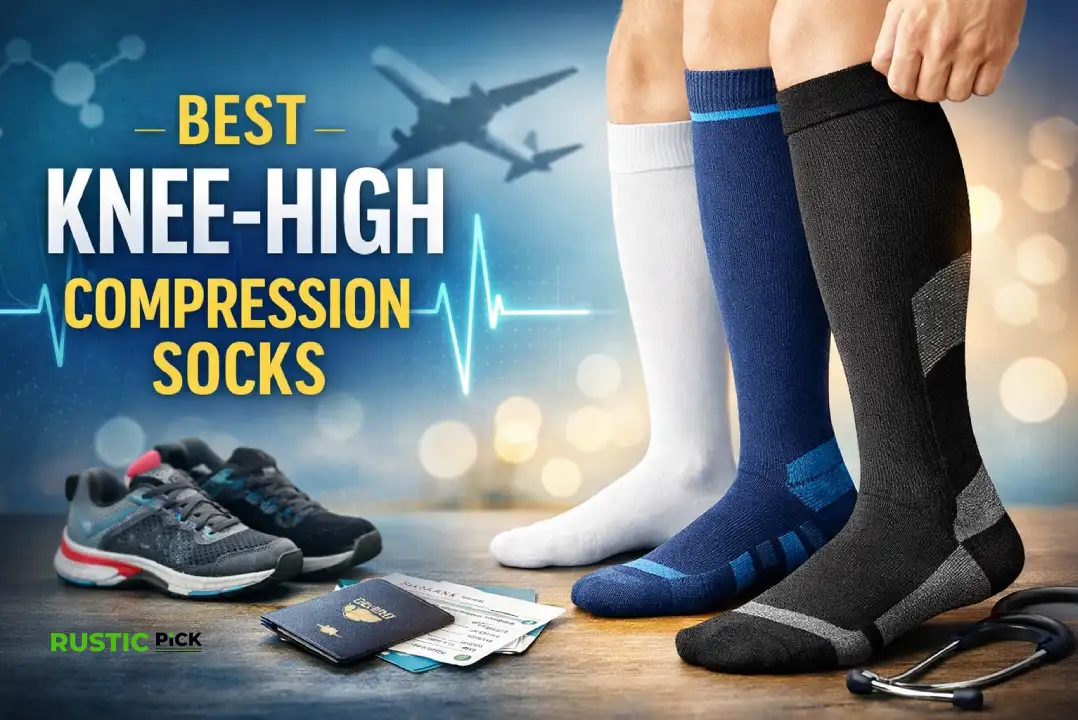
Finding good compression socks is like navigating through an oversized medical supply store with confusing jargon and dull color choices. But whether you’re a nurse walking a million miles on a 12-hour shift, a marathon runner, a frequent flyer hopping time zones, or just someone who constantly fights tired legs, the best knee-high compression socks can make a big difference in how your legs feel at the end of the day.
With RusticPick, you will get the marketing separated from the facts and genuine unbiased unique reviews. We’ve spent more hours than we can count on research, testing, and comparing the best products available to help you choose the best fit for your life.
So let us discuss the science behind compression, qualities of a great sock, and give you detailed review of the top ten best knee high compression socks that lived up for providing comfort, durability and an efficient circulation support for the entire day.
The Science of Support: How Compression Socks Work
Before we get into the best brands, a little background on what compression socks are and how they support your circulatory system is helpful. Gravity helps the heart to pump oxygenated blood down into fingers and toes. Although it’s much tougher to get that deoxygenated blood back to your heart. Tiny one-way valves in your veins help keep your blood moving in the right direction. When to get up and walk If you’ve been in one place for too long, either sitting or standing, you’ve been told to walk around now you know why. This stagnation causes that characteristic heavy, aching sensation, and with time it can cause swelling (edema) or even help form varicose veins.
The Magic of Graduated Compression
Here graduated compression comes to the rescue. Graduated compression socks are meant to exert the highest level of pressure at the end of ankle, a proportionate rather than uniform pressure, unlike regular socks. As the sock ascends your calf toward the knee, the pressure gradually relaxes.
That’s because the special design creates a light, constant massage that mimics the natural pumping action of your calf muscles. It softly compresses the vein walls which helps those tiny valves close as they should and it also pushes the blood upward, back to your heart. The result? Fresher legs, less swelling, and a much lower risk of deep vein thrombosis (DVT) especially when you’re parked for too long.
Understanding Compression Levels (mmHg)
Compression is quantified in millimeters of mercury (mmHg) the same scale as blood pressure. Selecting the appropriate level is the most important decision in your purchasing journey:
8–15 mmHg (Mild): Great for active people who need just a little more energy, relief for tired legs, and daily use. A good choice for travel, pregnancy, long periods of sitting or standing, and to help with mild swelling. You get noticeable support, but it’s not so challenging to get them on.
20–30 mmHg (Firm/Medical Grade): Frequently prescribed by doctors to treat moderate swelling, varicose veins, post-operative recovery, and athlete recovery. These are harder to get on, and they provide strong support.
30–40 mmHg (Extra Firm): Only for severe medical conditions such as lymphedema or severe venous insufficiency. These are to be worn only under the supervision of a healthcare professional.
Who Actually Needs Knee-High Compression Socks?
Short answer: nearly everyone should have a pair or two. The day-old stigma that compression clothing is for old people or people with severe health issues is outdated. There is a broad lifestyle representation in today’s market.
Healthcare Workers and Retail Staff: If you’re on your feet for 10,000 to 20,000 steps a day on hard hospital or retail floors, compression socks are your best defense against plantar fasciitis and end-of-shift misery.
Desk Jockeys and Remote Workers: Blood slows down when you sit for eight hours a day. A light compression sock stimulates your circulation when your legs are motionless beneath a desk.
Frequent Travelers: The combination of cramped airplane seats, cabin pressure changes, and immobility can lead to a perfect storm for DVT. A 15–20 mmHg sock is a travel must-have.
Athletes and Runners: Most athletes who wear compression socks during activity do so to reduce muscle oscillation (micro-vibrations that leads to muscle fatigue) and after activity to improve recovery.
Pregnant Women: Pregnancy results in more blood flowing through your body, and that means that more blood flows through your veins in your pelvis, which can cause pressure, and swollen ankles. Compression stockings offer a safe, natural, drug-free alternative.
The Best Knee-High Compression Socks: Reviews and Recommendations
At RusticPick, we rated them by a tough compression socks evaluation standard: real graduated compression, material quality, breathability, ease of wearing, washing durability, and overall value.
Below is our detailed review of the 10 best knee-high compression socks on the market currently.
1. Comrad: Best for Everyday Lifestyle Wear
Comrad is the company that changed the industry by producing socks people actually want to wear. They come close to providing the two things you want in medical socks: functionality and modern-day style.
The Details: Comrad’s flagship knee-highs, “Companion,” carry 15–20 mmHg of compression. They are made with a proprietary blend of recycled cotton, nylon, and spandex.
Performance & Comfort: The remarkable thing about Comrad is how soft they are against your skin. They don’t have the stiff, clinical feeling associated with older compression brands. The toe and heel have light padding, and the top band is sufficiently wide so it doesn’t cut into the back of your knee.
Pros:
- Extremely soft fabric
- Chic, contemporary designs
- Easy to get on and off
- Eco-friendly materials
Cons:
- The 15–20 mmHg strength may not provide enough pressure for severe conditions
Verdict: Ideal for beginners, office workers, and everyday wear.
2. Bombas: The Champion of Cushioned Comfort
Bombas is already well established in the world of socks, known for its philanthropic “buy one, give one” model and its comfortable designs.
The Details: With 15–20 mmHg of compression, these socks use moisture-wicking fabric and arch support.
Performance & Comfort: Targeted cushioning in the footbed is especially helpful if you stand on hard floors. The honeycomb arch support system provides a comfortable fit.
Pros:
- Superior arch support
- Solid build quality
- Seamless toe
Cons:
- Slightly expensive
Verdict: Great for people with foot fatigue and long standing hours.
3. Sockwell: Best for Natural Merino Wool
Sockwell has perfected the natural fiber compression sock, which is a combination of luxurious Merino wool and sustainable bamboo rayon.
The Info: Available in a range of compression strengths; 15-20 mmHg is the standard.
Performance & Comfort: The natural thermo regulation and insect and anti microbial treatment of Merino wool keep your feet comfortable and odor free.
Pros:
- Excellent moisture management
- Temperature regulation
- Odor resistance
Cons:
- Requires careful washing
Verdict: Ideal for outdoor use and people with sweaty feet.
4. Sigvaris: Medical-Grade Support That’s Worth Every Penny
Sigvaris is a brand that doctors and vascular specialists often recommend.
The Information: Comes in a variety of compression grades 15-20 mmHg to 40+ mmHg.
Durability & Comfort: Durable enough for the clinical setting, uniform pressure.
Pros:
- Clinically proven
- Durable
- Accurate sizing
Cons:
- Expensive
- Basic design
Verdict: Best for medical use and recovery.
5. Vim & Vigr: Best of Both Worlds
Vim & Vigr offers stylish compression socks without compromising functionality.
The Details: Available in 15–20 and 20–30 mmHg with multiple fabric options.
Performance & Comfort: Designed to stay in place without rolling or pinching.
Pros:
- Wide variety of styles
- Multiple materials
- Reliable compression
Cons:
- Cotton styles may feel less elastic over time
Verdict: Best for style-conscious users.
6. Pro Compression: Best for Athletes and Recovery
Designed for runners and endurance athletes.
The Details: 20–30 mmHg compression with durable synthetic fabric.
Performance & Comfort: Provides firm support and reduces muscle fatigue.
Pros:
- Strong compression
- Durable
- Great for recovery
Cons:
- Difficult to put on
Verdict: Ideal for athletes.
7. Jobst: The Trusted Name for Severe Swelling and Edema
A well-established brand focused on therapeutic compression.
The Details: Available in higher compression levels such as 20–40 mmHg.
Performance & Comfort: Comfortable yet effective support with durable construction.
Pros:
- Medical-grade effectiveness
- Durable
- Comfortable fit
Cons:
- Limited style options
Verdict: Best for serious conditions.
8. Feetures: The Specialist in Targeted Compression
Feetures offers anatomically designed socks for improved fit.
The Details: 15–20 mmHg compression with left/right-specific design.
Performance & Comfort: Lightweight, snug fit with strong arch support.
Pros:
- Anatomical design
- Lightweight
- Great support
Cons:
- Limited styles
Verdict: Best for active users.
9. Dr. Motion: The Best Budget-Friendly Option for Beginners
Affordable and widely available compression socks.
The Details: Available in 8–15 mmHg and 15–20 mmHg options.
Performance & Comfort: Comfortable and breathable, though less durable.
Pros:
- Budget-friendly
- Easy to wear
- Fun designs
Cons:
- Lower durability
Verdict: Best for beginners.
10. Snug360: The Best All-Around Price Performance Value
A lesser-known brand offering strong performance at a good price.
The Details: Focuses on 20–30 mmHg compression with durable materials.
Performance & Comfort: Ergonomic design prevents slipping and bunching.
Pros:
- Great value
- Comfortable fit
- Strong support
Cons:
- Limited sizing
Verdict: Great for long workdays.
Buying Guide: How to Pick the Best Pair
1. Nailing the Sizing
Measure ankle and calf circumference in the morning and follow brand size charts.
2. Selecting the Toe Style
Closed-toe for daily use, open-toe for breathability.
3. Fabric Matters
Choose based on comfort, durability, and use case.
Care and Maintenance
- Wash in cold water
- Avoid fabric softeners
- Air dry only
Not recommended unless advised by a doctor.
Not recommended unless advised by a doctor.
Because proper compression requires tightness.
Final Thoughts
Buying a good quality knee high compression socks is amongst the most simple and effective ways to enhance daily comfort and leg health. The trick is to work out what compression level and fit is best for you. Take all the measurements needed, think about your routines on daily basis and take some different options for test to choose the best for you.