Comparison: Copper Fit vs. SNUG360 Compression Socks

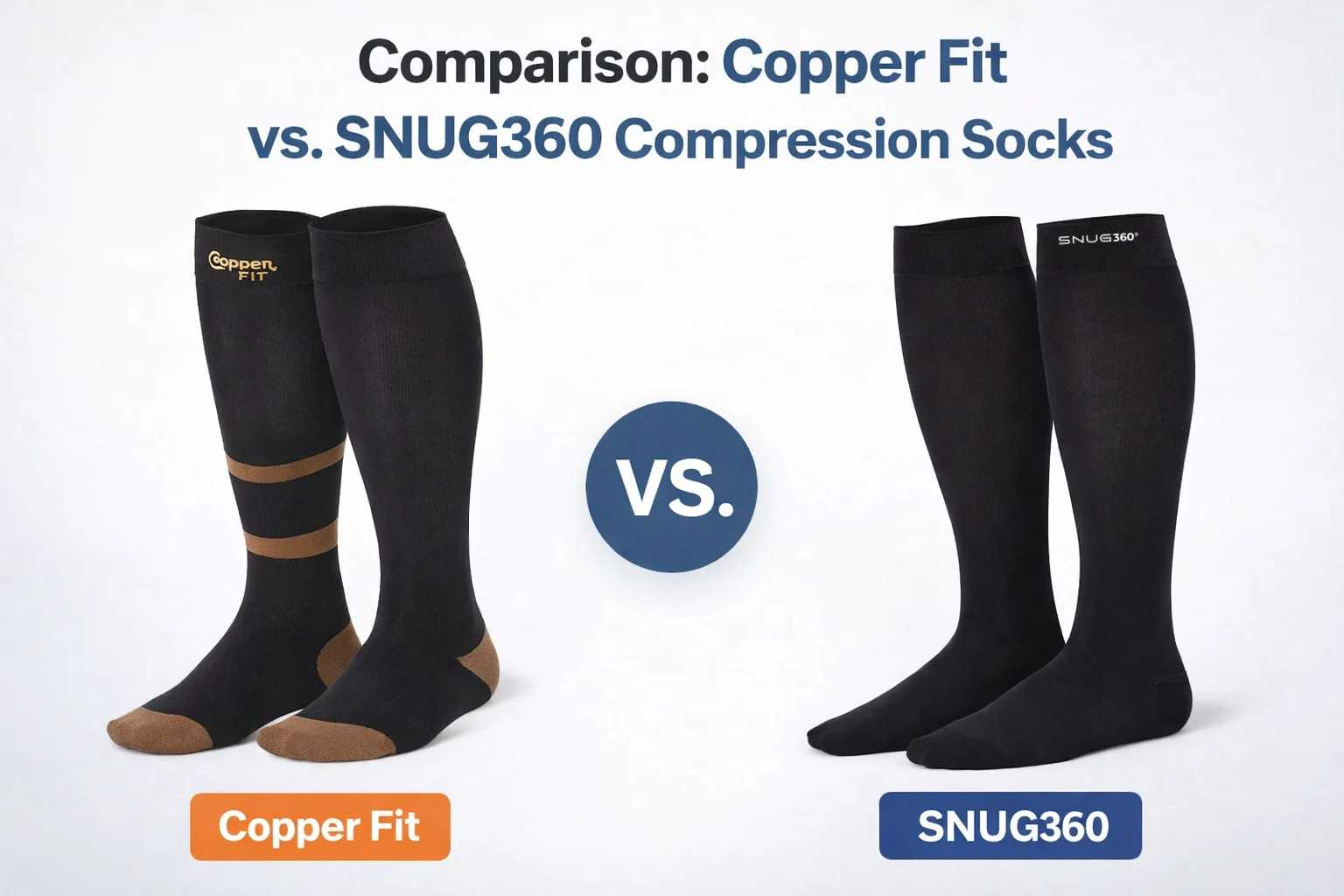
The battle between Copper Fit and SNUG360 is a classic case of Lifestyle vs. Medical.
If you are an active individual, a gym goer, or someone looking for a comfortable, odor-resistant sock to relieve mild fatigue during the workday, Copper Fit is the superior choice. It offers a “gateway” into compression soft, easy to put on, and stylish enough for the gym.
However, if you have medical swelling (edema), severe Plantar Fasciitis, varicose veins, or post-surgery, SNUG360 is the essential upgrade. Tighter, true graduated compression and a structural arch support that behaves more like a med ical device than a piece of apparel.
Context & Overview: The Compression Boom
Ten years ago, compression socks were beige, ugly, and sold exclusively in medical supply stores behind the pharmacy counter. They were associated with the elderly and post-surgical patients.
Today, compression is a booming industry. Athletes wear them to flush lactic acid; nurses wear them to survive 12-hour shifts; travelers wear them to prevent Deep Vein Thrombosis (DVT).
In this crowded market, two brands have risen to prominence through very different paths:
- Copper Fit: Copper Fit: Burst onto the scene with huge TV marketing campaigns, celebrity endorsements (Brett Favre, Jerry Rice), and a guarantee of getting the benefits of copper ions to the masses. They see themselves as an “Active Recovery” line.
- SNUG360: emerged from the orthopedic and therapeutic sector. Their branding is quieter, clinical, and focused on anatomical precision. They position themselves as a “Medical Support” brand.
This review dissects the marketing, the materials, and the mechanics to tell you which one actually belongs on your feet.
Brand Philosophy & Technology
To understand the product, you must understand the philosophy behind the manufacturing.
Copper Fit: The “Everyday Athlete” Approach
Copper Fit’s core philosophy is accessibility. They recognized that most people hate compression socks because they are impossible to put on, hot, and itchy.
- The Copper Infusion: The brand’s namesake feature is the infusion of copper ions into the polyester fibers. Copper is a natural antimicrobial element.
- The Goal: To create a sock that provides just enough support to feel good, while remaining soft enough to wear like a normal sock. They target the “weekend warrior” and the aging active adult.
SNUG360: The “Orthopedic Engineering” Approach
SNUG360 approaches the foot as a biomechanical structure that needs stabilization.
- The 3D Knitting: They utilize advanced circular knitting machines to create “zones” of compression. The heel, the arch, and the calf all receive different levels of pressure.
- The Goal: To manage pathology. Whether it is fluid buildup (edema) or micro-tears in the plantar fascia, SNUG360 designs products to fix a problem, not just to feel cozy.
Deep Dive: Performance Analysis
We have broken down the comparison into five critical categories: Compression, Comfort, Odor Control, Durability, and Ease of Use.
1. Compression Strength & Efficacy
This is the most important factor. Compression is measured in millimeters of mercury (mmHg). The higher the number, the tighter the squeeze.
Copper Fit (8–15 mmHg / 15–20 mmHg) Most standard Copper Fit socks fall into the mild to moderate range.
- The Experience: It feels like a firm hug. It is noticeable, but not restrictive.
- The Efficacy: This level is excellent for preventative care. It helps keep blood from pooling if you sit at a desk all day. However, if you have significant swelling where your ankles disappear by 5:00 PM, Copper Fit often lacks the “crushing” power needed to mechanically pump that fluid back up the leg.
SNUG360 (20–30 mmHg) SNUG360 targets the firm / medical-grade range.
- The Experience: It feels like a blood pressure cuff that is slightly inflated. When you take them off, your legs feel lighter because the blood has been forced out of the surface veins and into the deep veins.
- The Efficacy: This is compression therapy. It is sufficient to treat varicose veins, severe edema, and post operative swelling. It employs true graduated compression – that is, tightest at the ankle (100% pressure) and progressively loosens as it travels up the calf (70% pressure). This is a pressure gradient that is physically necessary to pump fluid against gravity.
Winner: SNUG360 (for medical efficacy); Copper Fit (for casual use).
2. Comfort & Fabric Feel
If a sock works but is too uncomfortable to wear, it fails.
Copper Fit
- Material: Usually a blend of polyester, spandex, and copper-infused nylon.
- Tactile Feel: Extremely smooth and “slick.” They slide into shoes easily. The fabric is moisture-wicking and feels very similar to high-end athletic socks (like Nike Elite).
- Breathability: High. They are designed for gym use, so they vent heat well.
SNUG360
- Material: Often a denser blend of Nylon and Spandex.
- Tactile Feel: More textured and “grippy.” They feel substantial. The fabric is thicker to maintain the high compression levels.
- Breathability: Moderate. Because the weave is tighter to create compression, they can run warmer than Copper Fit.
Winner: Copper Fit is undeniably more comfortable for all-day lounging.
3. The “Copper” Factor & Odor Control
Does copper actually do anything, or is it a gimmick?
The Science: Copper is bacteriostatic. It inhibits the reproduction of bacteria and fungi. The smell from sweaty feet comes from bacteria digesting your sweat. Therefore, copper-infused socks do reduce odor.
- Pain Relief Claims: There are many comments on joint pain relief with copper. However, the scientific consensus is that copper in fabric does not get absorbed in to the body in large enough amounts to chemically alleviate arthritis pain. It’s doubtful that any pain relief that wearers of copper-infused garments report is attributable to the copper.
The Comparison:
- Copper Fit: The copper infusion is their headline feature. In testing, Copper Fit socks resist odors exceptionally well, even after being worn for a heavy workout and left in a gym bag.
- SNUG360: They use standard moisture-wicking synthetic fibers. They are hygienic, but they lack the active antimicrobial properties of the copper infusion.
Winner: Copper Fit.
4. Ease of Use (The “Grandma Test”)
This is a critical buying factor for seniors or anyone with limited hand strength (arthritis).
The Challenge: Putting on compression socks is difficult. You have to bunch them up, stretch the heel, and pull them over the ankle.
- Copper Fit: Because the compression is lower (15-20 mmHg) and the fabric is stretchier, Copper Fit socks are easy to put on. They glide over the heel with minimal effort.
- SNUG360: Because they offer firm support (20-30 mmHg), they are difficult to put on. You need grip strength. You have to fight the elasticity to get them over the heel. Once they are on, they are great, but the process of donning them can be a workout in itself.
Winner: Copper Fit. (If you cannot put the sock on, it is useless).
5. Plantar Fasciitis Support
Both brands offer specific “Arch Support” or “Plantar Fasciitis” models.
- Copper Fit: Their arch support is usually a band of tighter elastic around the midfoot. It provides a gentle squeeze that feels nice but offers minimal structural change.
- SNUG360: Their Plantar Fasciitis sleeves are engineered with “lift bars” in the knitting pattern. They are designed to physically lift the plantar fascia ligament to relieve tension. They are significantly tighter and provide better stabilization for acute heel pain.
Winner: SNUG360.
Style, Price & Specs Table
| Feature | Copper Fit | SNUG360 |
|---|---|---|
| Primary Target | Active Lifestyle, Gym, Travel | Medical, Recovery, Orthopedic |
| Compression Level | Mild-Moderate (8–20 mmHg) | Moderate-Firm (20–30 mmHg) |
| Key Technology | Copper-Infused Ions (Antimicrobial) | 3D Circular Knitting (Anatomical) |
| Ease of Donning | Easy (High stretch) | Hard (High resistance) |
| Fabric Feel | Soft, slick, athletic feel | Dense, supportive, medical feel |
| Arch Support | Light elastic band | Structured compression zones |
| Durability | Elastic may loosen after 6 months | Retains elasticity for 12+ months |
| Styles | Ankle, Crew, Knee-High, No-Show | Open-Toe, Closed-Toe, Sleeves |
| Price Point | $ (Budget-Friendly) ~$12–$20 / pair | $$ (Mid-Range) ~$18–$30 / pair |
| Best For | Smelly feet, light fatigue, gym | Swollen ankles, Plantar Fasciitis |
Detailed Pros & Cons
Copper Fit
✅ The Pros:
- Accessibility: You can find them at Walmart, CVS, and Amazon. You don’t need to go to a specialty store.
- Odor Control: The copper technology genuinely works to keep feet fresh.
- Comfort: They feel like “normal” socks, making the transition to wearing compression much easier for beginners.
- Style: They come in neon colors, patterns, and cuts that look like standard athletic gear.
- Price: Generally cheaper per pair.
❌ The Cons:
- Lack of Squeeze: For people with serious venous insufficiency, they are simply not tight enough to solve the problem.
- Durability: The elastic cuff at the top tends to lose its grip faster than medical brands, leading to the sock sliding down the calf after a few months of washing.
- Sizing: Often sized S/M and L/XL based on shoe size, which is less precise than calf-circumference sizing.
SNUG360
✅ The Pros:
- Medical Efficacy: They provide the pressure needed to actually reduce edema and support vein health.
- Anatomical Fit: The heel cup and toe box are knitted to fit the shape of a foot, preventing bunching.
- Longevity: The high-quality Lycra/Nylon blend holds its “snap” (elasticity) for a long time, even with daily wear.
- Specialized Options: They offer open-toe versions (for summer/sandals) and specific Plantar Fasciitis sleeves.
❌ The Cons:
- Difficulty: Putting them on requires effort. This can be a dealbreaker for elderly users with arthritis in their hands.
- Heat: The denser fabric can feel hot in the summer.
- Aesthetics: While they have improved, they still look more “functional” and less “fashionable” than Copper Fit.
- Sizing: You must measure your calf. If you guess based on shoe size, you will likely get a fit that is painfully tight or uselessly loose.
Final Verdict: Which Should You Buy?
To give the best recommendation, we have to look at who you are.
Scenario A: The “Active Office Worker”
- Profile: You sit at a desk for 8 hours, or you stand at a register. Your legs feel a bit heavy by the end of the day, but you don’t have medical issues. You hit the gym a few times a week.
- Recommendation: Copper Fit.
- Why: You don’t need a medical vise-grip on your legs. You need light support and odor control. Copper Fit will keep your legs fresh without feeling restrictive, and they look normal in the locker room.
Scenario B: The “Nurse / Traveler / Pregnant Mom”
- Profile: You are on your feet for 12 hours straight, or you are flying internationally. Your ankles are visibly swollen (pitting edema) by the evening.
- Recommendation: SNUG360.
- Why: Copper Fit won’t cut it here. You need 20-30 mmHg of graduated compression to mechanically force fluid out of your lower extremities against gravity. SNUG360 will prevent the “cankles” and reduce the risk of blood clots (DVT).
Scenario C: The “Heel Pain Sufferer”
- Profile: You wake up in the morning and feel a stabbing pain in your heel (Plantar Fasciitis).
- Recommendation: SNUG360 Plantar Fasciitis Sleeves.
- Why: You need structural lift for the plantar fascia ligament. The SNUG360 design offers specific targeted compression zones that act like a soft brace, whereas Copper Fit mostly just offers warmth.
Scenario D: The “Senior with Arthritis”
- Profile: You have been told by a doctor to wear compression, but your hands are weak or arthritic.
- Recommendation: Copper Fit (Easy On/Off Models).
- Why: The best compression sock is the one you can actually put on. While SNUG360 offers better support, if you can’t pull them up, they are worthless. Copper Fit offers a compromise: lower support, but high usability.
Frequently Asked Questions (FAQ)
- Copper Fit: Yes. They are designed for standard machine washing. Wash on cold and tumble dry low. Avoid fabric softeners, as they coat the fibers and ruin the moisture-wicking ability.
- SNUG360: Yes, but be careful. We highly recommend using a mesh laundry bag. Then the socks don’t get tangled up with other garments, which stretches the elastic bands. To prolong the life of your compression products, air drying is recommended, but generally a low heat tumble drying is ok.
Compression socks are a “consumable” medical product. They do not last forever.
Tip: If you notice the socks are easy to pull on, they are dead. It’s time to replace them.
Copper Fit: Expect about 4 to 6 months of optimal compression with regular wear. After that, they become just “nice socks” without much squeeze.
SNUG360: Expect 6 to 9 months. The denser weave holds elasticity longer.
Imagine a tube of toothpaste. If you squeeze the middle, the paste goes both ways. If you squeeze from the bottom up, it exits the top.
Graduated Compression (SNUG360): Is tightest at the ankle and looser at the knee. This creates a pressure funnel that forces blood up toward the heart. This is essential for medical safety.
Uniform Compression: Squeezes the leg equally. This acts like a tourniquet and can actually trap blood in the foot.
Generally, No. When you are lying down, gravity is no longer pulling blood into your feet. Wearing tight compression (like SNUG360) while horizontal can restrict arterial blood flow into the feet.
Exception: Physicians occasionally recommend low-compression “anti-embolism” stockings for patients confined to bed as a preventive measure against clots. But for the everyday person? Take them off at night and let your skin breathe.
In high-quality Copper Fit socks, the copper ions are embedded in the yarn during manufacturing, not just sprayed on. They claim the benefits last for the life of the garment. However, like all antimicrobial treatments, efficacy does diminish slightly over hundreds of wash cycles.
Do not guess.
Chart: Compare these two numbers to the size chart. If you are between sizes, size up to avoid cutting off circulation.
Time: Measure first thing in the morning (when legs are least swollen).
Ankle: Measure the circumference of the narrowest part of the ankle (above the bone).
Calf: Measure the circumference of the widest part of the calf.