Verdict
The Mueller Adjustable Knee Support is the quintessential “everyman’s” brace. It strikes a difficult balance between the lightweight flexibility of a compression sleeve and the rigid stability of a hinged medical device. It is not enough to help with post-surgical ACL recovery, but it is the best non-surgical management for arthritis, meniscus pain, and minor ligament sprains that doesn’t break your budget. It is a rugged, heat-holding workhorse for the gym, the warehouse, and the trail.
Product Overview & Brand Heritage
To understand the product, you must trust the source. Mueller Sports Medicine is not a fleeting Amazon-only brand. Founded in 1959 by Curt Mueller (a former University of Wisconsin basketball player), the company literally invented the concept of sports medicine in the retail space. Before Mueller, athletes relied on heavy taping or hospital-grade equipment. Mueller brought athletic training room technology to the local pharmacy.
This specific model, the Adjustable Knee Support is one of their best-sellers because it targets the widest demographic: the “Level 2” user.
Understanding Support Levels
- Level 1 (Basic): Simple elastic sleeves (like Copper Fit). Good for warmth and mild swelling, but offers no stability.
- Level 2 (Moderate – Mueller Adjustable): Wraps with straps and flexible stays. Good for sprains, tracking issues, and arthritis.
- Level 3 (Maximum): Hinged braces with rigid metal bars. Necessary for major instability or post-op recovery.
The Mueller Adjustable sits firmly in Level 2, making it versatile enough for a CrossFit athlete with a tweak or a grandmother with osteoarthritis.
Design & Build Quality: Deconstructing the Brace
The brace may look simple, but its construction involves several distinct technologies working in tandem.
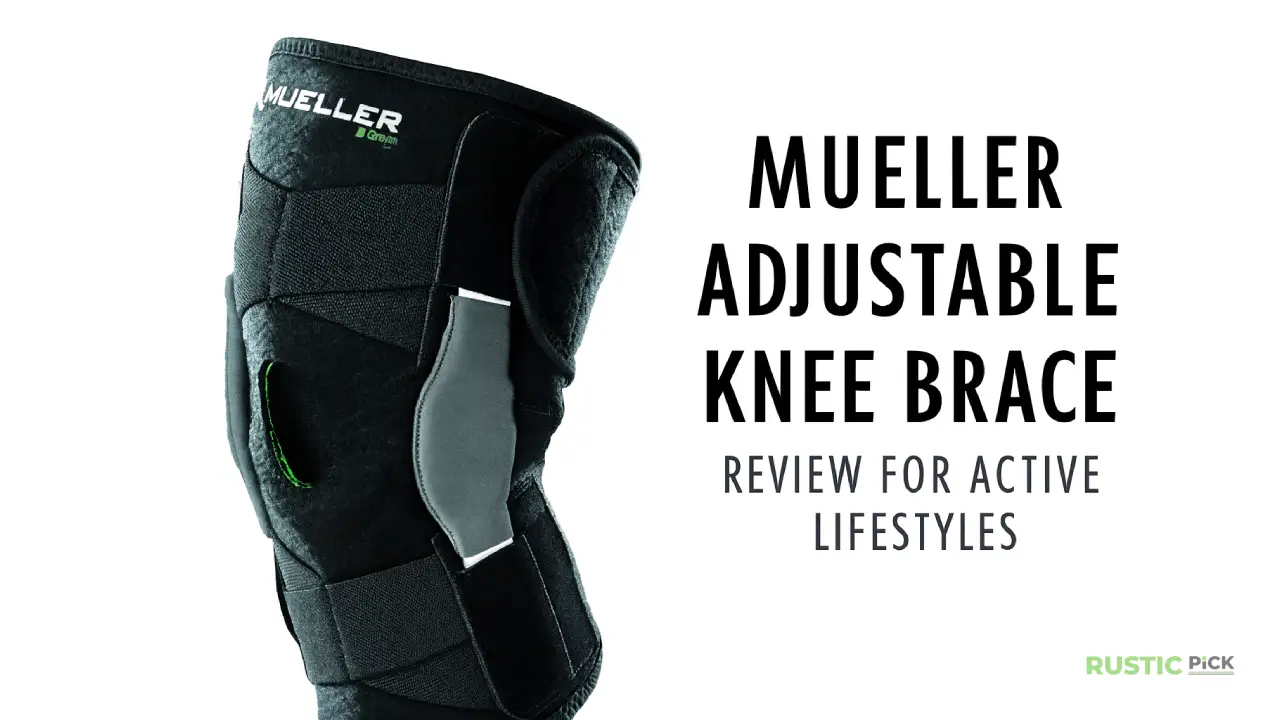
1. The Wrap-Around Design
Unlike a “pull-on” sleeve, this brace opens up flat.
- The Advantage: You do not have to take off your shoes to put it on. More importantly, if your knee is swollen (edema), you can adjust the fit to accommodate the swelling. A pull-on sleeve would be painful or impossible to get over a swollen joint.
- The Mechanism: It uses a two-layer closure. First, broad flaps secure the brace to the leg. Second, tension straps crisscross over the top to lock it in place.
2. The Open Patella Buttress
You will notice a hole in the front of the brace. This is not just for ventilation.
- The Buttress: Surrounding this hole is a thick, rubbery ring sewn into the fabric. This is the “patella buttress.”
- The Function: It acts as the cup for the kneecap. When the knee bends, the kneecap (patella) is meant to move in a smooth manner within a groove. If you suffer from “Runner’s Knee” (Patellofemoral Pain Syndrome), your kneecap is misaligned, scraping along the bone. The buttress actually compresses the kneecap into the groove, reducing that grinding feeling.
3. The Flexible Steel Springs
If you run your fingers along the sides of the brace, you will feel metal coils.
- Not a Hinge: These are not rigid hinges that lock your leg. They are flat, spiral steel springs.
- The Function: They act like tendons. They bend freely when you squat, but they resist lateral (side-to-side) movement. This is crucial for mild MCL/LCL sprains, where the knee feels “wobbly” side-to-side.
4. Material Science: Neoprene Blend
The core material is a neoprene blend.
- Heat Retention: Neoprene is a barrier to heat. It captures body heat and increases the temperature of the tissue in the area. Warm muscles and tendons are more flexible and less susceptible to injury. For those with arthritis, this heat is often the best source of pain relief.
- Perforation: To combat the “sweat factor,” Mueller perforates the neoprene (pokes tiny holes in it) to allow some moisture to escape, though it remains a warm brace by design.
Fit & Range of Motion: The “One Size” Reality
Mueller markets this as “One Size Fits Most.” In the world of orthopedics, this is a bold claim. Let’s break down the reality.
The Sizing Spectrum
- Fits: 12 to 20 inches (measured around the center of the knee).
- The “Sweet Spot”: This brace works best for average-sized legs (14–18 inches).
- The Small Leg Problem: If your knee is smaller than 12 inches, the Velcro straps will overlap too much. You will run out of “landing zone” for the hooks, and the brace will feel loose.
- The Large Leg Problem: If your thigh is muscular or carries extra weight (over 20 inches), the straps may pop open when you flex your quad. For these users, Mueller offers a “Plus Size” version of similar braces, but the standard model will be too small.
Range of Motion (ROM)
Does it restrict you?
- Flexion (Bending): You can achieve near-full flexion. You can squat parallel. However, a deep “ass-to-grass” squat will cause the material to bunch up behind the knee, which acts as a physical block.
- Extension (Straightening): The brace allows full extension. It does not lock the leg straight.
- Rotation: It limits twisting slightly, which is good for protecting the meniscus, but it won’t stop a severe rotational force (like a football tackle).
Performance in Sports/Workouts: Field Testing
We analyzed how the brace performs in specific activities.
1. Weightlifting & CrossFit
- Verdict: Very Good.
- Why: In lifting, you want warmth and proprioception (the mental awareness of the joint). The compression keeps the knee feeling “tight” and secure during heavy squats or deadlifts. The open patella prevents painful pressure on the kneecap when the quad is fully engaged.
- Drawback: It is bulky. If you are doing burpees or box jumps, the brace can feel heavy and may slide down if you are sweating profusely.
2. Running & Hiking
- Verdict: Good (with caveats).
- Why: For hiking, the lateral springs provide excellent stability on uneven terrain (rocks/roots). It gives you confidence that your knee won’t buckle.
- Drawback: Chafing. On a long run (5+ miles), the seams can rub against the skin. Additionally, the “pump” of the leg muscles combined with sweat can cause the brace to migrate downward. You may need to stop and readjust it every few miles.
3. Basketball / Tennis (Court Sports)
- Verdict: Moderate.
- Why: These sports involve rapid cutting and pivoting. While the Mueller brace helps, it is not a rigid ACL brace. If you have a history of knee instability, this brace might not be enough to prevent a blowout during a high-speed pivot. It is better suited for older players managing soreness than young players preventing acute trauma.
4. Manual Labor (Warehouse / Construction)
- Verdict: Excellent.
- Why: This is where Mueller shines. It is rugged. You can kneel on concrete, bump into pallets, and wear it for 8 hours. The heat keeps the old “war wounds” from aching during a long shift. It fits under loose work pants (like Carhartts) easily.
Durability & Maintenance: Making it Last
A brace is an investment. Here is how to keep it alive.
The Velcro Factor
Velcro is the weak link.
- The Problem: Over time, the “hook” side collects lint, hair, and fuzz from your sweatpants. Once it gets clogged, it won’t stick.
- The Fix: Regularly clean the Velcro hooks with a fine-tooth comb or a safety pin to pick out the lint. When washing the brace, close the straps. If you wash it with the straps open, the Velcro will tear up the neoprene fabric.
The “Neoprene Funk”
Neoprene is a rubber. It absorbs sweat and bacteria.
- The Smell: After two weeks of gym use, it will smell like a wetsuit left in a trunk.
- Washing: Hand wash in a sink with warm water and a mild detergent (or specialized wetsuit shampoo).
- Drying: Air dry only. Never put it in a dryer. Heat causes neoprene to become brittle and crack. It also melts the glue holding the buttress in place.
Structural Integrity
The steel springs are surprisingly resilient. They are capped at the ends and sewn into durable nylon pockets. It is rare for a spring to poke through, even after a year of heavy use.
Pros & Cons: The Honest Breakdown
| Feature | Pros (The Good) | Cons (The Trade-offs) |
| Support System | The 4-strap design creates a “cage” of support that is far superior to a simple sleeve. | It takes longer to put on than a sleeve. You have to align it correctly every time. |
| Comfort | The neoprene provides therapeutic heat that instantly soothes arthritic joints. | It gets hot. In the summer, your knee will be sweating significantly. |
| Fit | The wrap-around style accommodates swollen knees that can’t fit into pull-on sleeves. | The “One Size” is a gamble. If you have very skinny or very large legs, the fit is compromised. |
| Mobility | Flexible steel springs allow you to run and jump without feeling like a robot. | The material bunches behind the knee during deep flexion, which can pinch sensitive skin. |
| Value | At ~$20, it is disposable. If you lose it or ruin it, it’s cheap to replace. | It lacks the medical precision of a $100 Bauerfeind brace. |
Alternatives & Market Position
The Mueller Adjustable sits in a crowded market. Here is how it stacks up against the competition.
VS. The “Copper” Sleeves (Copper Fit / Tommie Copper)
- The Difference: Copper sleeves are thin spandex. They offer Level 1 support (compression only).
- Comparison: If you just want a little squeeze, buy Copper Fit. If you need actual mechanical support to stop your knee from wobbling, buy Mueller. The Mueller is 3x more supportive.
VS. McDavid 429X (Hinged Brace)
- The Difference: The McDavid 429X has rigid, geared hinges made of metal. It is a Level 3 brace.
- Comparison: The McDavid is for people who have torn ligaments. It is heavy, bulky, and restrictive. The Mueller is for people who might tear a ligament or just have sore knees. The Mueller is much more comfortable for daily wear.
VS. Bauerfeind GenuTrain
- The Difference: Bauerfeind is a premium German knit brace ($80+).
- Comparison: Bauerfeind is vastly more breathable and contoured. It fits like a second skin. However, it is 4x the price. Mueller offers 80% of the function for 20% of the price.
Final Verdict
The Mueller Adjustable Knee Brace is the Honda Civic of knee braces. It’s not the flashiest and it’s certainly not the most high-tech, but it is dependable, affordable and works for the vast majority of people.
It is ideal for:
- The Weekend Warrior: The 35-year-old playing pickup basketball who needs extra confidence.
- The Arthritic Senior: Someone who needs warmth and stability for gardening or walking the dog.
- The Manual Laborer: A warehouse worker lifting boxes who needs to protect their knees from strain.
It is NOT for:
- Post-Surgical Recovery: If you just had ACL reconstruction, listen to your doctor and get a rigid medical brace.
- All-Day Office Wear: It is too bulky to wear comfortably under dress pants while sitting at a desk.
Frequently Asked Questions (FAQs)
No. The design is bilateral. It fits the left knee or the right knee equally well. The straps are reversible in function.
You may, but you shouldn’t. The brace uses friction with the skin to remain in place. If you wear it over leggings or sweatpants, the contact between fabrics will be slippery and the brace will be sliding all the way down to your ankle after 10 minutes of running.
The standard Mueller neoprene blend contains natural rubber latex, which can cause severe allergic reactions (rash, blistering) in sensitive individuals. If you have a latex allergy, you must look for Mueller’s specific “Green Line” (Latex-Free) or choose a brand like Bauerfeind that uses knit fabric instead of neoprene.
Tightness is a balance.
The Danger: If you crank it too tight, you will restrict blood flow (causing a “throbbing” sensation) and potentially cause fluid to pool in your lower leg (edema). The brace should feel like a firm hug, not a tourniquet.
The Rule of Thumb: You should be able to slide one finger under the strap, but not two.
It is the most common myth. Wearing a Level 2 brace during activity (1–3 h) will not result in muscle atrophy. In reality, the brace can actually make you stronger, by allowing you to move more and exercise more vigorously, because it reduces pain. But you should not use it 24/7. Remove it when you are resting so that you can naturally recover your muscles.